Step 3 – Download the program Don’t try to install it yet, use the instructions below first. Enable Flash Player in Safari: Open Safari, and choose Safari > Preferences. Click the Websites tab and scroll down to the Plug-ins section. Click the check-box to enable Flash Player. Running Adobe Flash Builder on Win and Mac with Java 7/8 (UPDATED) By Krati Rastogi and Vivek Kumar Adobe® Flash® Builder® 4.7, which is an Integrated Development Environment (IDE) for developing games and applications using ActionScript and Flex framework runs on Java 6.
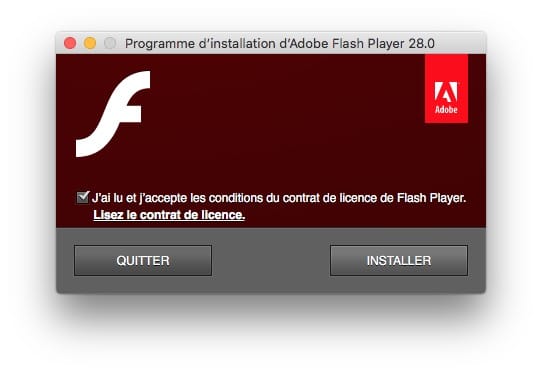
Are you tired of seeing an update like this on your Mac? Adobe asks you to download and install an update to Flash Player because they have made some significant improvements in the new version?
- Adobe Flash CS3 Professional (9.0.2) delivers support for the latest update of Adobe Flash Player 9. This update includes a new Video Playback component supporting H.264, support for Flash Lite 3 Update for Flash CS3 Professional, and all Debug and Release versions of this new Adobe Flash Player.
- Use this step-by-step guide to troubleshoot Adobe Flash Player installation issues on a Mac. Flash Player. Learn & Support. For Safari on Mac OS, see Enable Flash Player for Safari. For Google Chrome. Locate the Flash Player install file. Unless you have specified otherwise, the file is saved in your Downloads folder.
- The problem you are not able to install Adoble Flash PLayer on macOS Sierra is because of SIP (System Integrity Protection) which is preventing the app to write on the directory /var/folders/. To solve this you have to enter Recovery Mode of Mac.
- MacOS Sierra will snub Adobe's Flash Player. I guess that by now everybody knows how much of a security threat Adobe's Flash Player is to any Mac or Windows PC that uses it.
- MacRumors attracts a broad audience of both consumers and professionals interested in the latest technologies and products. We also boast an active community focused on purchasing decisions and technical aspects of the iPhone, iPod, iPad, and Mac platforms.
Years ago, Adobe confirmed that they have a major security vulnerability related to Flash Player, as discovered by Trend Micro and reported BGR. There doesn't seem to be signs that those vulnerabilities are completely fixed as Adobe keeps releasing new versions for their Flash Player app.
While updating Flash on Mac is just a few clicks away, I found the process tedious and most of the time — unnecessary. Because unlike the old days we had to use Adobe Flash Player to view web videos as they were mostly encoded in Adobe’s proprietary Flash format.
Not anymore! These days modern web browsers (i.e. Safari, Chrome, Firefox, etc.) all work seamlessly to YouTube, Vimeo, and many other live streaming web services — leaving Flash Player off the table.
So, it makes sense to uninstall Adobe Flash Player from your Mac so you won't be bothered by the annoying updates and potential security issues.
In this article, I'm going to show you how to do that step by step. Note: two methods are introduced in case the first one doesn't work out.
Method 1: Remove It with Adobe Flash Player Install Manager
Please note that the screenshots below are taken from Flash version 29, based on macOS High Sierra. If your Mac is running an earlier macOS or an older version of Adobe Flash, minor user interface differences may apply.
Step 1: On your Mac, go to Applications > Utilities, find this app 'Adobe Flash Player Install Manager'. Click to run it.
Alternatively, you can do a quick search on Spotlight and select the 'TOP HIT' result.
Step 2: Click the Uninstall button in the new window called Adobe Flash Player Uninstaller, where it says 'This program will remove Adobe Flash Player from your computer.'
Step 3: Input your Mac's username and password and select 'Install Helper'. Personally, I find this annoying but there isn't a way to avoid installing the Adobe helper tool.
Note: the helper tool by Adobe is harmless. It's common for third-party applications like Adobe to ask user's permission to perform certain tasks such as removing items with special permissions, uninstalling items from Mac App Store, etc., because macOS puts many limits restrictions on this.
Step 4: DONE. A new window pops up saying Flash was removed from my system.
Adobe Flash Player For Mac Os Sierra
This is the recommended yet standard method for deleting Flash Player from a Mac. It should take you less than a minute to complete. The only downside of this method is that once you uninstall Flash Player, you end up with installing another Adobe app — the Helper tool.
Some Mac fellows reported that they encountered issues using the Adobe Flash Uninstaller app on their Macs, it's unclear what caused that. But if Method 1 didn't work out for you, turn to the second method — it's even quicker.
Download Adobe Flash Player For Mac Sierra
Method 2: Uninstall Flash Player with CleanMyMac
CleanMyMac 3, is an app developed by MacPaw Inc. that aims to make Mac cleanup and maintenance easy. While its core features are related to cleaning, the app also allows you to quickly uninstall third-party apps or extensions in batch, and removing Adobe Flash Player can be achieved easily as well.
Here's how:
- Download CleanMyMac and install the app on your Mac.
- Open it. On the left part of the main panel, find Extensions > Preference Panes, there you should be able to find 'Flash Player'.
- Select it and click the 'Remove' button.
That's it. Pretty easy, right? It's worth noting though, CleanMyMac isn't freeware (it has a free trial). We use the app quite often on our Macs and it works amazingly well and has saved us tons of time handling complex/techy tasks such as freeing up disk space, cleaning third-party apps or launch agents, finding large old items, and more. The app is definitely a productivity booster for most Mac users, especially if you are not a computer person.
Additional tip: Adobe actually has a dedicated article here in case you failed to install or uninstall Flash on your Mac. For example, an error message appears. There you'll find detailed troubleshooting guide.
Alright, now that we've shown two ways to get rid of Adobe Flash Player from your Mac. Are they helpful? Or do you have another 'secret' way to help get the job done?
Either way, leave a comment below and let us know.
Chris is a computer geek for a decade. He loved talking to computers via codes, and now he finds it more interesting communicating with the real people. He now writes everything related to computer issues and loves helping people solve problems.
Adobe today released a new security-focused update for its Flash Player software in an effort to patch a series of vulnerabilities that could give attackers control of your computer. Although Safari on macOS Sierra disables web plugins like Flash by default, Mac owners who have a standalone Flash Player installed on their system are at risk, even if they’re using Flash Player that’s built into Google’s Chrome browser.
One of the vulnerabilities could allow for arbitrary code execution. Adobe has assigned today’s update its top priority rating so you’re wholeheartedly recommended to update your copy of Flash Player as soon as possible because Adobe itself states that the vulnerability could let an attacker take control of the affected system.
To update Flash Player to the latest available version, use the built-in update feature or download the new version from the Adobe Flash Player Download Center.
TUTORIAL:How to manually check for Adobe Flash updates on the Mac
Adobe said Macs with the following versions of Flash Player are affected:
- Flash Player version 23.0.0.162 and earlier
- Flash Player Extended Support Release version 18.0.0.375 and earlier
- Flash Player for Google Chrome version 23.0.0.162 and earlier
You can check your current version of Flash Player on Adobe’s website. If the web tool says you’re running Flash Player version 23.0.0.185 or later, you’re in the clear.
Adobe also pushed updates for Flash Player for Windows, Linux and ChromeOS.
TUTORIAL:How to remove Flash Player from your Mac
If you use Google Chrome, the browser’s silent update mechanism should ensure that you’re always running the latest version of both Chrome and the built-in Flash Player.
Those running the standalone Flash Player on their Mac should enable the option “Allow Adobe to install updates” in the Flash preference pan to automatically receive Flash security patches and other updates in the future.
Source: Adobe