- Adobe Flash Player For Mac Enable File-sharing
- Adobe Flash Player For Mac
- Adobe Flash Player For Mac Enable Location
- Adobe Flash Player For Mac Enable Right
By now, you’ve probably heard that the future of Adobe Flash isn’t bright. Plagued by security issues, Adobe Flash has always been a thorn in the flesh of software developers such as Apple and Microsoft, who finally said that enough is enough and decided to get rid of it. In this article, we explain why Adobe Flash matters and why you, as a Mac user, should care about its inevitable demise.
The Origin of Adobe Flash
To enable Flash in Google Chrome, go to a website that you trust and click the icon to the left of the URL in the search box. It will be one of the following, depending on if the site uses HTTPS or not: Google Chrome provides the possibility to ensure an advanced level of security when accessing. Select Allow sites to run Flash, then click Done to save the change. 3) If you want to add more sites that allow Flash Player, click the Manage exceptions button. 4) Type in the site address here and then click Done to save the change. Enable Adobe Flash Player on Firefox 1) Open your Firefox browser, on the top-right corner, click the three-bar icon and click Add-ons. 2) On the left side, click Plugins. Then click Shockwave Flash and select Always Activate from the drop-down menu. Adobe Flash Player 31 (Win, Mac & Linux) debugger (aka debug player or content debuggers) and standalone (aka projectors) players for Flex and Flash developers. – Updated debugger and standalone versions of Flash Player. If you already downloaded Adobe Flash Player, are using Safari on a Mac, and you're seeing a message telling you that you still need to download Adobe Flash Player, this is because you have it disabled in your system preferences. Adobe® Flash® Player is a lightweight browser plug-in and rich Internet application runtime that delivers consistent and engaging user experiences, stunning audio/video playback, and exciting gameplay. Installed on more than 1.3 billion systems, Flash Player is the standard for delivering high.
Adobe Flash started its arduous life in the 90s, when its precursor, named SmartSketch, was published by FutureWave Software. The rising popularity of the internet at the time made FutureWave Software realize that their vector drawing application had had the potential to challenge Macromedia Shockwave, a multimedia platform for building interactive multimedia applications and video games.
Enable Adobe Connect Flash Player Content debugging for Mac OS Google Chrome clients Objective This is particularly useful for debugging recording issues from Adobe Connect perspective specially in few versions prior to 9.6 where recordings only have an option to launch in flash player mode.
In 1995, FutureWave Software approached Adobe Systems and offered SmartSketch for sale. Adobe Systems, however, declined the offer, which led to FutureWave Software getting acquired by Macromedia and its subsequent rebranding to Macromedia Flash 1.0. Under Macromedia’s patronage, Flash quickly gained both market share and new features, including scripting and data access capabilities.
In 2005, Macromedia was acquired by Adobe Systems for approximately $3.4 billion. Adobe Systems added support for the ActionScript 3.0 programming language, improved the animation capabilities of Flash, included a 3D engine that allowed basic object transformations in 3D space, and allowed GPU-accelerated 3D rendering for Flash applications and games on desktop platforms, just to name a few noteworthy improvements.
The End of Adobe Flash
By the beginning of this decade, Adobe Flash, including Flash for Mac, has already established itself as a popular multimedia platform for building interactive multimedia applications and video games. In 2011, Flash was included in 99 percent of desktop browsers. Unfortunately for Flash, the platform had already entered the last stage of its life by that time.
Adobe Flash Player For Mac Enable File-sharing
In an open letter titled Thoughts on Flash, Steve Jobs explained why he decided not to include support for Flash in iOS, “Adobe’s Flash products are 100% proprietary. They are only available from Adobe, and Adobe has sole authority as to their future enhancement, pricing, etc. While Adobe’s Flash products are widely available, this does not mean they are open, since they are controlled entirely by Adobe and available only from Adobe. By almost any definition, Flash is a closed system.”
Most Apple shareholders would most likely consider this to be a good-enough reason to adopt HTML5, CSS, JavaScript, and other open standards instead, but Jobs had more reasons to stay away from Flash. “Symantec recently highlighted Flash for having one of the worst security records in 2009. We also know firsthand that Flash is the number one reason Macs crash. We have been working with Adobe to fix these problems, but they have persisted for several years now. We don’t want to reduce the reliability and security of our iPhones, iPods and iPads by adding Flash,” he said.
Apple wasn’t the only company that was sick and tired of the security plaguing Flash. As such, nobody was surprised when Adobe released a press release, officially stating that the company was planning to stop updating and distributing the Flash Player at the end of 2020.
“Adobe will continue to support Flash on a number of major OSs and browsers that currently support Flash content through the planned EOL. This will include issuing regular security patches, maintaining OS and browser compatibility and adding features and capabilities as needed.”
While most major websites have already moved away from Flash and, just like Apple, embraced HTML5, CSS, and JavaScript, some still depend on the deprecated technology, forcing many Mac users to keep Adobe Flash for Mac installed on their computers. If you count yourself among them, the first thing you should do is ensure that you’re using the latest version of Flash.
How to Update Adobe Flash Player for Mac?
To update Flash Player Mac, complete the following steps:
- Open Apple’s Spotlight app by pressing the command key on your keyboard and hitting the space bar.
- Type Flash Player.
- You should see an option titled “Flash Player.prefPane” under System Preferences. Click on it.
- Go to the Updates tab.
- Click on the Check Now button.
- If Adobe Flash Player finds any available updates, it will prompt you.
How to Download Adobe Flash Player for Mac?
Follow the steps below to download Flash for Mac:
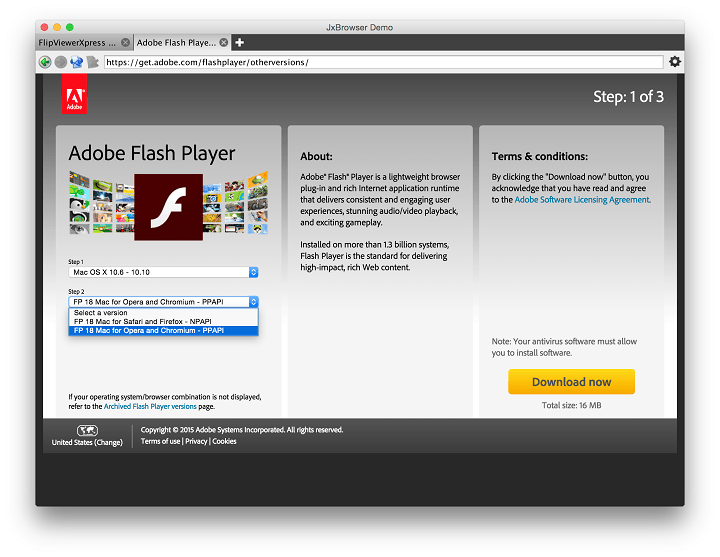
- Go to the official download page: https://get.adobe.com/flashplayer/otherversions/
- Select your operating system (Mac OS X 10.6 – 10.13) from the first drop-down menu on the left side of the page.
- Choose whether you want to download Adobe Flash Player for Mac Chrome and Opera or for Safari and Firefox by clicking on the second drop-down menu on the left side of the page.
- Click on the Download now button on the right side of the page.
- Install Flash for Mac just like you would any other Mac software.
How to Disable Adobe Flash Player on Mac
Considering how often are new Flash security vulnerabilities discovered, it makes sense to keep Adobe Flash Player disabled and activate it only when you really need it.
Safari
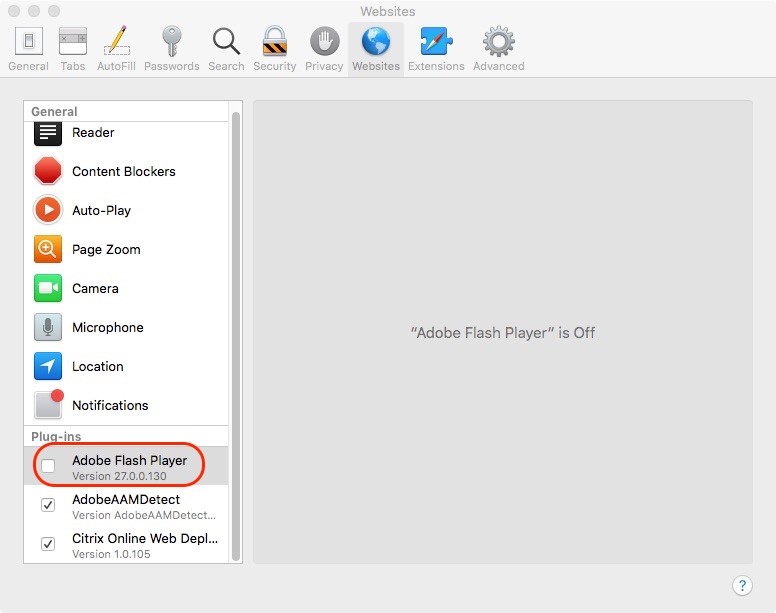
- Open Safari and go to the Menu bar and click on and then Preferences.
- Click on the Security button and then Plug-In Settings.
- Uncheck Adobe Flash Player from the left-hand menu.
- Click on Done to finalize the change.
Chrome
- Open Chrome and type in the following in Google Chrome’s location bar and press Enter: chrome://settings/content
- Find the Flash Player listing on the Content settings screen and click on it.
- Uncheck the Allow sites to run Flash option.
- Close the chrome://settings/content tab to confirm the change.
Firefox
- Open Firefox and type in about:addons in the Firefox address bar.
- Click on Plugins on the left-hand side.
- Look for Flash and select either Never Activate or Ask to Activate from the drop-down box right next to it.
- Close the about:addons tab to confirm the change.
How to Enable Adobe Flash Player on Mac
The most straightforward way how to re-enable Adobe Flash Player on Mac computers is to simply uninstall it. Doing so will also ensure that you’re using the latest version and enable Adobe Flash Player on Mac across all installed web browsers and applications that use it. Alternatively, you can follow the instructions from the chapter above to re-enable Adobe Flash Player in individual web browsers.
How to Uninstall Adobe Flash Player on Mac
Adobe has created a dedicated uninstaller for Macs, and you can download it here.
- Launch the downloaded uninstaller like you would any other Mac application.
- Click on the Uninstall option.
- Make sure you don’t have any web browser open on your computer as the uninstaller wouldn’t be able to complete the uninstallation process.
- When you see the message notifying you that the uninstallation succeeded, click Done.
- Delete the following directories:
- <home directory>/Library/Preferences/Macromedia/Flash Player
- <home directory>/Library/Caches/Adobe/Flash Player
- Restart your computer.
- Visit this page to check if Flash Player is installed on your computer.
- The same page also contains links to many Flash tutorials from Adobe.
How to Recover Files After Adobe Flash Malware Infection
Adobe Flash is among the most popular attack vectors used by cybercriminals to infect Mac computers. For example, in January 2018, a hacker successfully disguised dangerous malware as an Adobe Flash Player installer, probably targeting diplomats and other high-profile individuals.
If your computer had been infected with malware because of Adobe Flash, causing you to lose important files, there’s still some hope left — provided you act quickly enough. There are a number of data recovery software solutions for Mac computers that can recover even those files that your Mac can no longer see.
One such software solution stands out because it blends excellent usability with state-of-the-art data recovery algorithms, and its name is Disk Drill.
Disk Drill is a professional yet easy to use data recovery application that supports the recovery of over 200 file formats from virtually all storage devices. To use it, you simply launch it, select the storage device from which you would like to recover lost or deleted files, and click on the Recover button right next to it.
Of course, Disk Drill also allows you to precisely control the recovery process. As a nice bonus, Disk Drill comes with several extra free disk tools, including a duplicate file finder, a disk space analyzer, a data protection “Recovery Vault”, a disk monitoring utility, and a data backup tool for creating byte-to-byte disk and partition backups. Visit the official website of Disk Drill to download it for free.
Adobe Flash Player For Mac
Your Companion for Deleted Files Recovery
Safari is the default browser on Mac. Over period of time it will load very slow and ultimately most of us will end up in using Google Chrome. You will never turn back to Safari, once started using Chrome. By default Chrome has a Adobe Flash Player plugin but it will ask you before loading the pages with Flash player.
In this article we will explain, how to enable Adobe Flash player in Mac Chrome and other options to control the behavior.
- Default Chrome behavior – ask first
- Possibility of enabling Flash on all sites
- Flash option in Chrome to allow or block specific sites
1. Default Behavior of Chrome – Ask to Enable Flash for Specific Site
When a page with Flash content is loaded, Chrome will show the “Click to enable Adobe Flash Player” message with a puzzle piece like below. This is because the default settings for Flash content is to ask for permission before run.
You can just click on the message and then click “Allow” button (on some cases, you may directly see a popup message to allow or block running Flash).
Allow Flash in Chrome for Specific Site
This will enable Flash player only on that particular site. When you allow the site to run Flash content, Chrome will automatically add the site in the exception list in the settings. From next time onwards, the site will load the Flash content without asking permission.
2. Enabling to Run Flash by Default – Removed on Latest Chrome
Remember Flash is basically a multimedia platform to play videos and games online. Since Flash players has lot of security vulnerabilities, HTML5 is used in all modern websites instead of Flash. Also running Flash content will drain the battery life of your Mac. Considering all these facts, Apple does not offer Flash player for Safari.
But Chrome comes with already installed Flash player and asks your permission before running. Earlier Chrome had a “Allow sites to run Flash” option, which is removed in latest Mac Chrome version. So there are no ways to enable Flash on Chrome on all the sites by default. This is a clear indication that the “Flash” section will be removed soon from the Chrome to encourage sites to use HTML5.
3. Allow or Block Flash for Specific Sites
Now the latest Chrome version has only options to allow or block Flash on specific site. Open the command URL “chrome:settings/content” on the browser’s address bar.
Adobe Flash Player For Mac Enable Location
Scroll down and click on the “Flash” option.
Open Flash Settings in Chrome
It will open up the next screen with multiple options like below. As you can see the default option is “Ask first (recommended)”, hence Chrome will ask with the message “Click to enable Adobe Flash Player”.
Let us check out all the options to control the Flash settings for your need.
1. Ask first – This is the default behavior and Chrome will ask you before running Flash as explained above. It is also a recommend option by Google. Disable this to block sites from running Flash by default. When you block Flash content, Chrome will show the below message on Flash enabled sites.
Blocking Adobe Flash Player
2. Block – add URLs of the sites you want to block Flash content. Use this option when “Ask first” is enabled.
3. Allow – add URLs of the sites you want to allow Flash content. Click on the “Add” button against “Allow” option and enter the trusted site’s URL. Use this option when “Ask first” is disabled.
Summary
Below table shows the summary of using Flash options in Google Chrome on Mac. You can choose the suitable combination for your need.
| Ask first | Block | Allow | |
| Completely Block Flash | Disable | ||
| Completely Enable Flash | NA | NA | NA |
| Ask Before Running on All Sites | Enable | ||
| Block on Specific Sites and Ask on All Other Sites | Enable | Enable | |
| Allow Only on Specific Sites and Block on All Other Sites | Disable | Enable |
We have just marked the completely enable flash option as “NA (Not Applicable)” which essentially means you can’t do this.
Adobe Flash Player For Mac Enable Right
Adobe announced the end of Flash support by 2020 and the browsers like Chrome will stop Flash support with similar timeline.